I present a lot on sleep; what it is, how it works and the many benefits to our physical and mental health. Without fail, I get asked questions regarding sleep aids, usually about the latest craze in sleep related gadgets.
Daily Rhythms
Time cues and anchors to our day have never been so important. In a period of unrest and change, such as with Covid-19 and the disruption it has brought to our lives, having regular synchronicity to our day is important not only for our physical, but also our mental wellbeing.
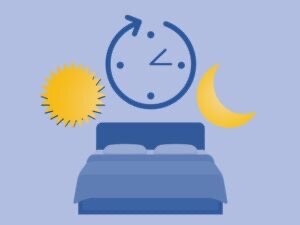
Why? The answer lies deep in the brain and our relationship with night and day.
Inherent to all humans is a natural, intrinsic rhythm. A circadian rhythm. Essentially it is a recurring cycle over 24 hours which governs our body’s need to maintain balance (homeostasis). It regulates all our biological and physiological processes and helps our bodies respond and adapt to any environmental changes. Everyone has a circadian rhythm which changes throughout our lifespan; from babies to teenagers, generally settling in adulthood and altering again as we age.
Throughout day and night our circadian rhythm drives several body processes such as digestive activity, body temperature, physical activity, alertness, hormone levels, immune function and perhaps most critically, sleep. It is the sleep rhythm that is so important to consider as it it significantly impacts on all areas of our physical and mental health.
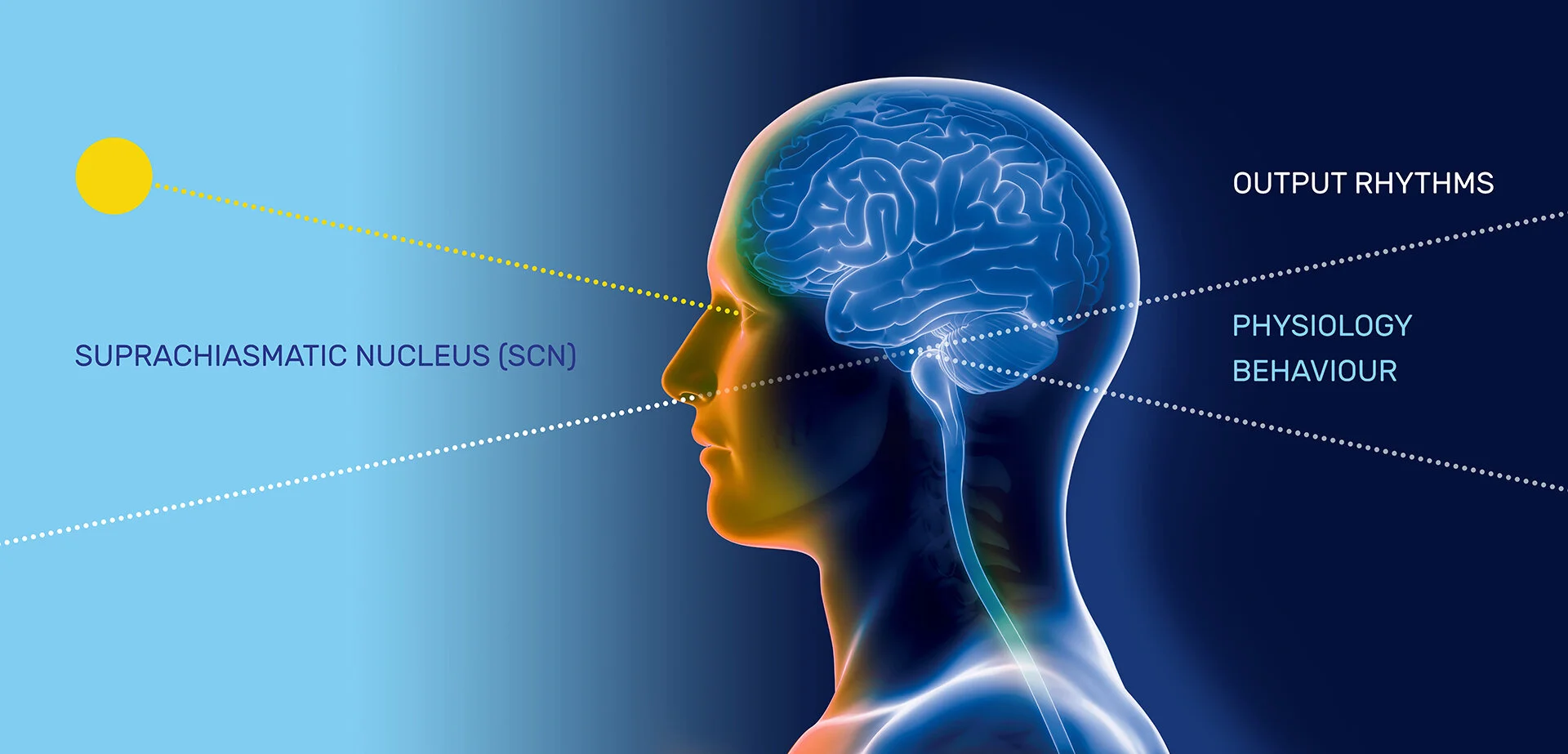
We are all generally entrained to a 24 hour circadian rhythm, of which our sleep/wake rhythm is inextricably linked to the light/dark cycle. How we interact with light and dark involves a complex interaction of photic (light) information which passes through the retina, deep into the brain, to the hypothalamus which houses the governor of our circadian rhythms, the Suprachiasmic Nucleus (SCN). If this becomes damaged in any way our circadian rhythm becomes offset and body balance (homeostasis) is disrupted. The level of which depends on how desynchronised our light/dark cycle has become.
In terms of sleep, under normal circumstances, the circadian rhythm will naturally rise in the early morning as depicted by the dark blue line in the below illustration, promoting wakefulness and alertness, and will reach a peak in the evening. After a waking period of approximately 14-16 hours the pressure to sleep increases and we become tired. With the onset of darkness, the circadian rhythm drops to the lowest level, a hormone called Melatonin is released, and sleep ensues (The Sleep Council 2020). This is why regularity breeds sleep and our daily routines are so important for promoting good sleep habits. In normally entrained individuals, your circadian rhythm interacts with this homeostatic sleep drive in an opposing manner to provide consolidated wakefulness during the daytime hours and continuous sleep during the night. When this doesn’t occur sleep problems can exist and you should seek advice from your GP regarding persistent disruptions to your sleep/wake cycle.

Typically our regular rhythm of sleep and wake fall into our daily routine of life events (work, school etc.). Through our daily routine we have natural time cues or ‘anchors’ that help us maintain the body’s balance in terms of where it’s at at any given point in the day i.e. hungry, tired, seeking light etc. However, circadian rhythms can become disrupted through a number of ways, either external factors (e.g. shift work, travel, lifestyle, health condition) or a sleep disorder. When daily life gets interrupted, such as is the case during the Covid-19 pandemic, our daily anchors become offset and it is easy to lose the routine, with sleep patterns often paying the price.
The good news is ensuring you maintain a healthy daily rhythm, in the absence of our normal time cues, can be achieved following some simple steps - outlined below. Try some of these if you're experiencing difficulty with sleep or maintaining a daily routine during this most bizarre of times.
Sleep strategy
Develop a ‘strategy to sleep’ and ensure you’re getting the recommended 7-9 hours sleep
Ensure you have a sleep routine with a regular bed time and get up time.
Regular bed and wake times help sleep onset & ensure sleep is maintained throughout the night. Set a wake-up time and work backwards in 90 min cycles to get the right bed-time.
Avoid regular excessively late nights or long lie ins
Only go to your room when you’re ready to sleep.
Be realistic if making changes e.g. try 3/7 nights at first
Protect your sleep time.
Environment & Behaviours
Seek natural sunlight as much as possible during the day
Eat at normal meal times with a small snack in between if needed
Avoid large meals before bed
Ensure you have a sleep environment to help good sleep (calm, low light, no noise, comfortable, ambient temperature)
Avoid devices in bed/bedroom - minimise exposure to blue light
Avoid stressful news/situations before sleep time
Try some gentle interventions to help poor sleep e.g. cognitive behavioural therapy (CBT - see your GP for advice)
Engage in some physical activity regularly (preferably outside if possible)
Avoid screen time before bed
Limit caffeine & alcohol intake (avoid excessive caffeine, alcohol especially before bed)
Use sleep medication as a last port of call. See GP. Only take sleep medication once you’ve exhausted all other practical strategies to improve your sleep.
Recognise everyone has an individual need. What works for one person might not work for you.
Change one aspect of your sleep strategy at a time, then you know what works for you.
Sleep health articles
Here’s a link to some recent articles I’ve written on aspects of Sleep Health
Healthy sleeping
I’ve written a short commentary on sleep and the immune system in this unsettling of times for global health. Hope it helps!
https://www.linkedin.com/pulse/healthy-sleeping-dr-sarah-gilchrist-/?published=t
New post…. sleep extension
Check out my new article following on from last month’s ‘Sleep Strategies’, all about the benefits of a good nap!
https://www.linkedin.com/pulse/sleep-extension-dr-sarah-gilchrist-/
New post....Strategies for good sleep
Check out my new article regarding good sleep strategies
https://www.linkedin.com/pulse/strategies-good-sleep-have-you-got-one-dr-sarah-gilchrist-
It's not all about the numbers....
I’ve been thinking about my Doctoral thesis quite a bit recently, mainly as a lot of performance conversations I’ve been having are around ‘impact’; an area I focused on somewhat in my thesis. The challenge with impact is how do we measure it? How can we objectively or subjectively define the impact we have had in a project or piece of work we’ve been focussing on? A challenge for all industries, and one certainly faced in the high performance sport industry where support staff are regularly asked to provide a measure of their ‘impact’ to world class performance programmes. So here are some thoughts on using different methodologies for measuring impact based on my experiences in high performance sport and with my Doctoral thesis…
Read moreReflections on graduating
I had my graduation ceremony this week for my Professional Doctorate in Sport. A time for reflection and I was reminded of this article that I provided for the University of Kent earlier this year. The article provides some insight into how I found the PD could be produced without becoming too stressful an experience. headlines were:
Having a good supervisor who you can touch base with when you need them and lets you have flexibility in your thought processes.
Studying a topic you are passionate about and can immerse yourself in, consistently, for a number of years!
If you’re thinking of pursuing a professional doctorate, or PhD, I highly recommend it - be bold and grab the opportunity!
https://blogs.kent.ac.uk/unikentsportsci/2019/04/11/sarah-gilchrist-professional-doctorate-graduate/
The power of human connections
I’d never considered connections in much detail before. By that I mean human connections. The tangible ones you make in everyday life. Being a professional, in a position of employment, you don’t often appreciate the human connections you have in your vicinity, nor use them to full effect. Only when you’re out in the big wide world as an independent agent, do you really experience the power of human connection, and the art of using it to full effect.

A recent phase of long standing professional connections contacting me for pieces of work, plus new connections offering some exciting opportunities, have caused me to reflect and be grateful for the power of human connections; how they can further our professional development in areas of expertise, or even enable us to grow in areas we hadn’t necessarily considered. Undeniably, working independently has opened my eyes to a world of new connections, some I’d hope to make myself, and achieved, others spontaneous and several through a mutual connection who recognised areas of commonality.
Described as ‘the art of the action of linking one thing with another’ (Oxford Dictionary, 2019), developing human connections certainly are an art, particularly when you want to use them for real impact. The ‘action’ of linking one to another resonates with me as, however new connections have been made, there certainly seems to be an art to it.
These reflections have prompted me to put some thoughts together on making connections and how my scientist brain has had to further develop the ‘art’ of making them. Note, this is not a ‘how to make connections’ list. Merely some personal observations from my recent development in making connections.
As a process, the power of human connection was highlighted initially to me when I started my own business and proactively used my existing connections to help establish contact with people in areas, I knew I needed to develop, or wanted to pursue a new interest in. From here, opportunities and connections escalated. At one point it was too much, a little overwhelming and I had to reign myself in as my ideas from conversations with new connections were taking over my ability to stay focused and prioritise my work flow. I had commitments to deliver pieces of work and didn’t want to be in a situation where these circumstances were compromised by being over committed. In short, I had to understand the art of managing connections, old and new, and how to prioritise new ideas and work flows from such connections.
As I discovered, whilst motivating, it’s also quite exhausting meeting new people a lot of the time. Having focused conversations, listening, responding, reacting to ideas in the moment, all require a certain amount of focused cognition, so I learnt quite quickly to space out new connections. It helped that the new connections I was making weren’t all face to face. A lot of initial conversations were over the phone, so I could take some time to quietly reflect after the meeting.
Of course, there’s always the financial element to consider when making connections. Nevertheless, I was surprised at how kind and accommodating new connections could be when financial gain wasn’t involved. I used this as my gauge. If someone was asking for money from the outset or didn’t seem overly interested in my development, skill set or I didn’t feel they had my best interests at heart, I quickly moved on.
The beauty of the art of making connections is that it is infinite. Where a pursuit of information and knowledge may end when you’ve gleaned sufficient information for your task or project, there is always the next topic to learn or develop and a new connection or contact required. Fundamentally, the need for making new connections or revisiting old ones, never receives closure if you’re motivated to be in a persistent phase of growth and development.
So, what closing messages would I like to convey as to the power of connection? There are a few and I’ll try to be brief!
Accept a link might not work at first, or only for a short period. Some connections are a ‘pilot’ for what’s to come. Learning and being aware of how to gauge what works for you or doesn’t is part of the art of human connections. Accept short and long term connections and be patient and accepting during the process of finding, making and establishing a them. As an example, I knew I needed a new mentor of late and was becoming a little frustrated in how and where to make the right connections. Yet patiently waiting for the ‘right’ connection has enabled me to find someone who very well suited for what I need at this stage in my career. Also, consider the fact that, whilst you may have free time at a particular point, that doesn’t mean the people you’re trying to connect with either know that, nor are they equally available.
Engage with possibilities and keep an open mind. A connection may not seem to be what you’re hoping for, but when you meet and get a dialogue going, there’s typically scope for benefit for both parties. This might not be immediately obvious, but keeping an open mind helps you observe your interaction and reflect on how it may support you.
Be modest. Having humility in your connection’s will help in establishing new relationships and ensure people will want to corroborate you. Being overly confident may persuade new connections that actually, you don’t need any help. Again, the art comes in displaying skills in direction and confidence without overstating yourself too much.
Finally, be grateful for having the time to embrace opportunities to engage with new people and organisations, particularly in areas novel to you. Be thankful for those connections you have made and how they may support you in future endeavours. In short, practise the art of making connections at every opportunity and you never know where it may lead…...
Dr Sarah Gilchrist, 2019
Quality assurance: the mundane but necessary friend
Using my experiences of directing physiological laboratories for the English Institute of Sport and more recently, my role as a reviewer for BASES laboratory accreditations, with a year to go to the Tokyo 2020 Olympic and Paralympic Games, here’s my take on why quality assurance (QA) is so important.

Quality assurance: the mundane but necessary friend
Calling all laboratory users! What’s your most valuable asset in your laboratory? It goes without saying that your team are pretty fundamental, but one aspect of your laboratory, which underpins everything that you do, is your reliable, yet slightly mundane friend, quality assurance.
Not known for being the most fun party guest, quality assurance is a crucial element for any laboratory setting, as it serves to provide robust standards for equipment performance.
Specifically, it ensures systematic measurement, comparisons with known standards and monitoring of processes, with the aim of preventing significant error in the outputs of equipment. Not something you want occurring when supporting your athletes with a coach peering over your shoulder. In the world of Sports Science, this equipment is mostly physiologically based, but the premise of quality assurance; its provision of vigorous measures in equipment reliability, validity maintenance and routine servicing, has relevance across all disciplines and neither be ignored nor treated as inconsequential.
Impact is another important factor to be considered in relation to quality assurance. As a practitioner, assessing the impact of Sports Science support can be a predominantly subjective process. Having a structured quality assurance programme for your physiological facility, allows you to display quantifiable improvements in the assessment of the athletes you are supporting. Therefore, quality assurance serves as supporting data in the assessment of a practitioners impact to a sport/athlete.
In the applied world, physiological laboratory equipment can often be deployed out to the field. Nevertheless, placing significance on quality assurance procedures, both in the laboratory and out in the field, will hold you in good stead for being confident in your equipment when working in some extreme environments.
Operational competence i.e. risk assessments, can also be demonstrated through quality assurance procedures, alongside the all-important, health and safety criteria. In short, it is a crucial element for any laboratory setting.
So, how can you demonstrate quality assurance? Firstly, and more subjectively, is through employee behaviours and practices within your laboratory. Taking responsibility for recording necessary data for quality assurance purposes and respecting equipment are fundamentals to all users of a laboratory, ahead of their personal objectives for their research. Equally, reporting of equipment failure should be a priority of any laboratory user, alongside an accompanying proactivity to work together to get the problem solved!
Formally, you can demonstrate good quality assurance practices through gaining laboratory accreditation status. Here, in the UK, we use the British Association of Sport and Exercise Sciences Laboratory Accreditation process to accredited our Sport Science laboratories (https://bases.org.uk/spage-organisations-laboratory_accreditation.html). This is a quality assurance activity that provides clients and service purchasers with a means of confirming the appropriateness of a laboratory to conduct physiological testing. Benefits are, that it provides a mark of quality assurance to clients, research funders and the wider community, that illustrates the laboratory has undergone rigorous inspection by BASES and that high professional standards of practice have been achieved (BASES 2019). Having this process in place through an external organisation ensures objectivity, knowledge share and promotes continuous improvement in sports science standards.
So use your most valuable laboratory asset well. Nurture it, ensure it has everything it requires and respond to change if needed. Coaches and athletes will be the first to ask questions if laboratory equipment is substandard, so cover your back and ensure you’re one step ahead at all times. Mundane as it may be, quality assurance is a fundamental skill to learn and maintain and central to your laboratory’s ability to deliver gold standard results.